Showing posts with label florida. Show all posts

Tuesday, January 14, 2020

2020 Bassmaster Eastern Open Lake Toho

For the last week leading up to the first tournament of the season, its officially been upside down day for 7 days. Outside of Florida the entire country is experiencing winter weather with reports from clients in Wisconsin that they have up to an inch and a half of ice. On everything. Meanwhile, in Central Florida where anglers will launch from downtown Kissimmee Lakefront Park with a full field expecting to fish in conditions that usually would be windy, cold, rainy, they will enjoy lows of 61 degrees to start and and blustery high of 82. Weather that fits more along with November or March.

South winds out of Miami will continue to impact the temperatures and ultimately destroy any anglers hopes of fishing shallower than 4 feet in search of bedding bass or doing what Florida is famous for, catching big bass in the grass. The conditions will make for a challenging event that will possibly highlight some of the competitors that have traveled from Northern lakes where open water is more of their comfort zone.

The upside of having a tournament on the Kissimmee Chain of Lakes is that there are no shortage of big bass and there will be a good number of Pros who find them and make the event as exciting as it always is when Bassmaster comes to town.

So, what are the bass doing and how will they probably be caught?

For the last 2 months bass have been residing in 4-5 feet of water along with the forage they have been feeding on. During the last full moon they were gorging as they went into a full blown spawn with water temperatures dropping to 62 degrees. The coldest we have seen this winter. But it was a quick wave of spawners that only lasted a day which worked out great for my client pictured, Kent took advantage of by landing this massive 10 lb 2 oz Toho trophy.

That quick burst of spawning activity was followed by a rise in water temperatures that have the lakes running at 71 degrees at the time of this writing. Fog and cloud cover have helped to hold temperatures down but the fog may play into the tournament with a delayed launch. The good news is that if you can find the bass in an area they are feeding in, there will be a wad of them that can hold up for the entire three day tournament as the weather looks to be holding steady rather than turning drastically like it can in Florida.

This might be the most I've ever written about the weather but it will be a large factor for this tournament. But enough about that.

Lake conditions are great with water quality above average on all lakes. Hydrilla was sprayed again in October but only Cypress and Lake Kissimmee show the results from that. Lake Toho, which always factors into a win for this tournament has submerged vegetation all over the lake. Don't be surprised to see some big bags come from 6-8 feet of water. The bass are there but to be successful, more wind will be needed to trigger them to feed.

In a recent tournament on Lake Toho, it was won using a Carolina Rig in open water hydrilla for a 26lb bag. It was much colder during that tournament but I expect this technique to still play heavily in who is able to crack the top ten.

In another first, I'm going to predict a hard jerkbait could also be a key bait for a high finish on Toho based on where the bass are positioned and how they are feeding. Shiners are the key bait right now and few baits mimick them well. A hard jerkbait is on that tackles that job well. The variety of baits can range from a floating Rapala, a Bagley Bango Lure, Yo Zuri 3DB to include a personal favorite, A Bomber Long A.

Another bait that not many talk about outside of Kentucky and Florida is the 10 inch worm. With light winds expected throughout the tournament, a Zoom Old Monster could take us back to its glory days of dominating tournaments with the most fundamental lure ever made. This particular presentation will require a great deal of confidence from whomever throws it as it will provide quality bites but not a high number. Missed fish could be a factor talked about a lot during the weigh in.

Chatterbaits, Swim jigs and Spinnerbaits are usually good options this time of year in Florida but I don't expect them to factor in unless winds get above 10 mph this week.

Time for my usual weight predictions for this tournament. Honestly, I don't want to venture into throwing numbers out there because fishing based on the last week have been challenging unless using shiners. That's not unusual for this time of year but the temps and winds should mean lure fishing is on fire as well. That hasn't been the case.

But I've never been shy about sticking my neck out so no reason to stop now!

Average weights for the the top 10 should range from 27lbs as the high and 16lbs at the low. The field will be stacked tight in weights between 13 and 16lbs. The Pro that leads day one will struggle to repeat the same number over 3 days. Launch times will be huge with bass feeding early and becoming less active after 10 am. Pros making the run to Kissimmee or other lakes may end up back in Toho early to try and salvage a limit. Total winning weight should be around 56 lbs. To be in top ten, 36 lbs might get someone there.

Its all going to be a huge gamble with one angler hitting the jackpot for the 1st place prize that they all are chasing. I'll be on the water hoping for lots of big bags and great results.

By Steve Boyd
Owner - Florida Bass Adventures

Wednesday, January 31, 2018

BASSMaster Eastern Open on Lake Toho

BASSMASTER Eastern Open Season Opener On Lake Toho

For weeks now anglers have been preparing for the season opener of the Bassmaster Open Trail on Lake Toho. Even though January tournaments held on Lake Okeechobee are traditionally the first of the year, Lake Toho is what Competitors and fans look forward to.

And they all have good reason to look forward to it. Lake Toho has a proven ability to break records and be a game changer for competitors as well as fishing industry product manufacturers. While the overall tournament weight has been broken, the one day 5 bass limit is still owned by Dean Rojas and Lake Toho.

It's amazing how much that tournament dictates what the Pros competing in this tournament do during practice time. I can tell you that every day for the last week the same areas Dean Rojas caught his winning limit from are getting checked by at least 15 boats each morning. Sadly, they all leave disappointed as the once in a lifetime conditions that helped Dean win are still "once in a lifetime".

But it's not just a record breaking history that anglers are looking forward to with this tournament. There's one thing that Winter brings to Florida that everyone else gets hot under the collar about, Fat Bottom Girls! While Winter in other parts of the country mean regular reorganization of lures in the boat because of ice on the lakes or making long runs to power plant lakes just to cast a lure, we look for big girls in Florida.

In tournaments like this one it's not enough to find a quality limit with a solid kicker because that might not even make the cut. They will need to look for big fat females with lots of junk in the trunk! And the great thing about fishing on the Kissimmee Chain is this can happen on any cast.

But that doesn't mean it will be easy. The obvious question is, will competitors be able to adjust to the changing conditions and movements these bass are making to bring big bags to the scales? On shallow water lakes such as Lake Toho many elements play a role in bass behavior that can create havoc for anglers trying to figure out their movements. And this week will be a perfect example of changing conditions that will feel very similar to Dean Rojas's record breaking win.

A cold front just came through Florida that brought water temperatures down into the high 50's that will heavily impact the first day of the tournament. But the front will play more of a mind game on anglers than anything else. The past two days have seen high winds that might make many anglers question the areas they have been fishing. But tomorrow will be a competitors dream day for spawning bass.

The forecast is calling for a launch temp of 49 degrees with very little wind throughout the day. So, while the morning bite might be initially slow, the mid day bite could be on fire with bass making a massive move into spawning areas benefitting later flights. Either way, many competitors might have to leave fish that they have found on beds because they are out of time.

Does that mean the tournament will be a sight fishing slug fest? My prediction is no because water temps aren't cold enough to push the bass shallow and the water color is too stained to sight fish the deeper bedding fish.

While I have some ideas on what to expect from winning weights and what will be needed for a top 10 finish the unkown will be with winning lake. It's easy to go with Toho right now because the lake looks great. Lake Toho is probably the easiest to fish of all 4 lakes right now but the advantage will go to Pros who have a long history fishing there as the fish are not in the typical areas anglers expect. A one day tournament last weekend took 23 lbs to win that came out of Lake Toho. Expect the top 3 finisher to come out of this lake with a potential average of 25lbs per day.

Lake Kissimmee is fishing small but the areas that are producing holding some big bass. Having an early flight and making the run to Kissimmee could pay off for the first two days of the tournament but it's doubtfull to get three days out of those areas to win. Expect a top five finisher to come out of Lake Kissimmee.

Lake Cypress. Cypress is always a sleeper in these tournaments and I can personally attribute a top 3 finish in a BFL to this lake. Winds for the last few days could make the bite here tough but with light winds predicted for the tournament expect some kicker fish to come from this lake that could be the difference in a win or 6th place.

Lake Hatchineha looks the best I have seen it look in 10 years. It's doubtful the tournament will be won from this lake. The last time it happened was around 1998. My expectation is that Hatchineha will be part of a milk run that will help finish out some daily limits that contribute to a top 10 finish.
So, how many Fat Bottom Girls will we see come across the scales? There is a good chance we will see one Big Bass in the 11lb range be caught and be the big fish of the tournament.

I'm predicting a tight start to the event with a few 20lb plus bags being caught on day one but the real competition will start on day 2 as conditions get ripe for more big fish being caught. Heading into the final day look for someone to make a big leap in the standings to challenge for the overall win.

I won't make any angler predictions this year. The last time I did I picked Shaw Grigsby and he bombed and now he acts like he doesn't know me!!!!

Winning weights should hit 75lbs and top 10 finishers will need to be in the 50lb range.

Should be a fun tournament to keep up with and hopefully the Kissimmee Chain will represent as it always does!

Steve Boyd
Florida Bass Adventures

Friday, April 14, 2017

Best Practices When Handling Bass

Following is a two part article regarding best practices when handling and releasing bass alive. Part 1 will cover initial actions when catching a bass and what can be done to help them survive the process.

Recently, the University of Florida conducted a study of how handling a bass impacts its ability to survive after being handled by anglers. The study focused solely on the grip used to hold a bass out of water immediately after being caught. The person conducting the study was not a highly knowledgeable angler or one who had any experience with catching and releasing large bass.

When the word got out that this study was going to be done I contacted Fish and Wildlife and asked why anglers like myself or other guides were not contacted for input on the study. The response I got was that the study was being controlled by University of Florida and they awarded the money to the person doing the work.

Not the best answer I could have hoped for considering this study might get some merit simply because it had a university's name on it.

The results of the study? No definitive results could be concluded from the study. Feeding times of fish handled after being caught varied slightly based on angle at which they were held but not at a consistent level to be considered scientific.

With all of that being said I like to propose a broader approach to handling a bass that starts from the moment they are caught to the moment they are released. The thought behind this approach is based on 15 years of guiding, handling numerous big bass and releasing them alive. Many that were caught on more than one occasion validating the success of how they were handled.

Some situations will make my proposal more difficult to follow. If you are fishing in a river system with strong current or a lake with lots of trees please make the best attempt to follow the following suggestions as you can.

To begin let's look at a scenario of hooking a bass and the actions that take place after it is hooked.

Once a bass is hooked it has an initial response to pull back and fight. The struggle and energy the bass expends will put a strain on it's muscles and just like humans will push lactic acid into them. The longer the fight, the more lactic acid that ends up in their muscles.

Think of when we lift weights and the effects we feel afterwards. The pain is the result of the lactic acid that is pushed into the muscles and the blood that follows trying to heal broken down cells. This pain takes some time to clear our bodies and allow us to get back into the gym.

For a bass this is one part of how they can struggle to survive being caught and surviving afterwards. Catching a bass in a tournament and releasing them alive gives us the idea that they survive but this is what isn't always known. Not all bass float to the surface and die. Some take days to die and still do not float to the surface.

The only way we can do something that helps this is to reduce the lactic acid build up. How do we do this? The best way is to slow down the rate at which we try to bring the fish in. Once a bass is hooked it only takes a second to slow down and in turn, the bass will calm down.

Many might doubt my thoughts on this but for 15 years I've done with with countless anglers and watched as they have proven my theory to work 100%. I personally have done this will small mouth and know it works on them as well.

The added benefit to doing this is your catch rate goes up significantly and lost fish rate goes down to about 1%. For tournament anglers this is money in the bank.

The photos above are of a fish we named Frankenstein. We caught and released this bass 9 times over a 3 week period. 

By Steve  Boyd
Owner - Florida Bass Adventures
Orlando Trophy Bass Fishing Guide

Thursday, November 10, 2016

Proper Rod Position For Increased Hook Ups When Bass Fishing

Today's tip is one that is designed to increased your percentage of bass landed after the hook set. If you are a tournament angler or trophy bass hunter this tip is important because landed bass or missed bass can make the difference between a tournament win or trophy catch of a lifetime.

Wherever you live more than likely, you have been taught to keep the rod down especially for anglers that predominantly fish for smallmouth bass to keep them from jumping. Unfortunately, what has been passed down from generation to generation has been inaccurate with no ability to prove that it works. Like most of my tips I will emphasize the understanding of physics and the use of our senses to help determine the correct choice for the best outcome. 

From my observations of clients there is a strong belief that keeping the rod tip down can prevent a bass from jumping, but the reality is nothing can keep a bass from coming to the surface. Bass use the path of least resistance to determine what response is best once they have been hooked so you don't have to have a physics degree to know that if we are pulling down, the easiest path for them is up. This is true whether you are in deep water or shallow water but shallow water fish have less of a choice so they are more inclined to seek the surface. Smallmouth bass are nomadic type bass that leads to them being a stronger fish with more endurance than a largemouth meaning surface jumping to attempt to shake a hook is always a possibility. 

So, if pulling down isn't the best option, what is? First, lets start at the hook set and what you can do immediately after. Once you set the hook the most important thing you can do is hold there for a second and feel what direction the fish is headed, the size of the fish and consider any obstacles that might be in the way. I would call this assessing the situation and it allows time to slow things down and make correct decisions and adjustments to what the bass is doing. The other benefit to taking that second is calming yourself down and in turn not begin to reel too fast or horse the fish into the boat. I can't begin to tell you how many clients I have shown that when you stop yanking the fish to the boat they actually calm down and will swim towards the boat rather than fight for their lives. It's why clients sometimes call me the "Fish Whisperer". 

How I found out that a fish will follow like a dog on a leash was while I was fishing a lake here at home in about 16 feet of water. I had pulled up some line during a cast and felt it would be a good idea to get it out of the lake. As I pulled on the line I felt a slight tug and new there was a fish on. As I slowly pulled up the line I could see it was a big bass. It swam almost all the way to the surface only trying to swim away at the last minute as I began to lip it. From that moment on I knew bringing fish to the boat became more of a process of staying in the moment and not getting carried away. 

Now, as I said earlier bass will attempt to surface regardless of what angle you pull. The benefit of keeping the rod up is having the ability to see the line and as it begins to go horizontal, you can bring the rod down and pull the fish back into the water forcing it to swim. Then bring the rod tip back up to once again have visibility on the line. This is the action/response that should happen between the angler and fish once hooked. The fish will make a choice and it is up to us to respond accordingly. Just remember there is always more than one option to the action.

 One last thought. It is always good to consider what we lose by keeping the rod tip down and what is gained from keeping it up. The first thing we lose when holding the rod tip down is our ability to see the line and one of our senses, vision. If you are setting the hook upward, by going down with the rod, you immediately take away line sight. Being able to see the line tells us what direction the fish is going and allows the opportunity to make adjustments to what they are doing.

Getting a bass to bite your lure in my opinion is the hardest part of catching them. After learning that once on the hook my response and actions to what the fish is doing will be the ultimate factor in whether or not I end up holding them has meant more catching and less fishing. Give it a try and hopefully you will too.

Thanks for reading,
                                Steve Boyd
    Owner - Florida Bass Adventures Guide Service
                 http://www.floridabassadventures.com
                   http://www.orlandobassguide.com
                  https://www.orlandobassfishing.net
                   http://www.laketohoguide.com

Thursday, July 7, 2016

Florida Black Bass Length Limit Regulations and How They Impact Bass Fishing in Orlando

At the end of June Florida enacted new statewide harvesting regulations for all species of bass. This new regulation will have equal numbers of proponents and opponents from each side arguing their points. Even though my living is based on the quality of our bass population my view on this is as objective as possible but realistically its hard to be against anything that can possibly have a positive impact on a resource.

The old regulations allowed anglers to possess 5 bass above 14 inches with only one being allowed to be above 21. Those length limits were in place for many years and the result of decimation to lakes in the state that were the result of no limits or management in place at the time. The time allowed to determine if those regulations were working was a positive in my mind especially considering we went from no limits to a limit.

During the initial regulation many things changed in the world of bass fishing, technology and social impacts from the age of internet. These impacts played more of a role in the declining success of the old regulations than the regulations themselves. Essentially, times were changing rapidly and for those of us who have lived here our whole lives it was obvious a change was needed.

Now this isn't to say people here in Orlando or the state of Florida were screaming for changes. This is where I have to applaud the state for being proactive. Yes, anglers in the state are vocal and involved but most of the time it has to do with plant management or management of an individual lake. Local anglers are predominantly tournament competitors so catch and release is popular so they didn't have much reason. Anglers who used to keep bass have moved on to crappie, bluegills and bream and aren't the type to complain.

In this case I truly believe the trend of today where anglers are influenced on where to fish based on social media, BASS and FLW tournament results which are real time. Or in the case of Florida, the best place to go for big bass in the winter was more of a deciding factor on what changes were needed.

The issue with the latter is when no one else can fish, our bass are spawning. And in no fault of those who come down to experience this, bass that are trying to reproduce are under attack at the highest point of the year. They are also in areas that make them most vulnerable. Bed fishing with shiners might be considered cheating at the worst for tournament anglers but for tourists coming to catch and eat their legal catch it's all the rage.

Can you blame them? I might not like it and definitely don't agree with it but they have been in their right to do this. Unfortunately, there have been many occasions where visiting anglers would come with 3 to a boat, catch a legal limit, (15 with 3 over 21) and take them to shore. Put them in a cooler, come back out and repeat the process. And when they come, they fish all day non stop. This process has been a factor in our trophy bass populations but to be clear, it is not the only one.

These anglers will be impacted the most from this new regulation where 5 bass can be kept with no minimum size restriction and of those 5 only one can be over 16 inches. Because of the believe that if they are spending money to catch bass, they should be able to eat their catch for a meal and get a return. And historically, keeping the biggest bass possible was part of the process.

Anytime I talk to someone about eating bass it seems that almost all agree that a 2-3 lb bass is the best to eat. But speaking from childhood experience, that isn't what happens. My family were some of the worst offenders of keeping and killing trophy bass without thought every weekend. Seeing a big bass getting filleted was not a rare thing in my house and it left an impression. Mostly because if you lived in that era and still fish as I do, you know how different times are.

The new regulations have some foundation in Ray Scott's philosophy of properly harvesting a fishery to help increase trophy bass populations. Smaller fish are always the most aggressive and make competing for food more difficult for larger bass that evolve into ambush predators as they get larger. Weeding out smaller bass has been proven to be the most successful tool for increasing trophy bass populations.

An immediate benefit of the new law will be the cost required to catch a bass if your intent to keep it. Wild Shiners have always been the best option for catching trophy bass. But now, an angler can go out and use minnows, crickets and night crawlers to catch a limit of crappie and bass at the same time. Previously the bass caught while crappie fishing would be too small to keep but now that will change. This should result in increased numbers of anglers who can keep bass compared to before the new regulations. Best of all, the increase in harvested bass wont mean a decrease in large bass numbers.

For those coming to catch a trophy, the odds have the potential to go up and best of all a trophy bass can become more of a photo op rather than a meal. Steve Boyd
Owner - Florida Bass Adventures
http://www.floridabassadventures.com

Saturday, January 18, 2014

An Orlando Bass Fishing Trip to Remember

The 2014 Orlando bass fishing season is underway and it has been nothing short of amazing! The cold weather is going to come but so far this winter it has been more of a wet season without the brutal cold fronts that many in the North are dealing with. A low pressure system was kind enough to park over the state of Florida and with it came 2 weeks of rain and clouds. Perfect for big bass fishing in Orlando!

George Eby was a recent benefactor of the weather and great bass fishing we are having with a trip to Lake Toho. What many in the area were not aware of was that the conditions had become perfect for the bass on Lake Toho to move up in a massive wave of spawning activity in the span of a few days. One of which happened during George's day on the water. Live bait was the bait of choice for this trip with the goal of catching his biggest bass ever. It will be a day George remembers for a long time.

The morning started out rather slow with a clouded sunrise on our first spot but after a short wait we boated our first bass of the day, a healthy 4lb bass. Soon after we made the move to our second area and not long after the bite started and it was a full on explosion of big bass. George landed his first big bass and largest ever, a long and healthy bass weighing in at 8lbs. One of the most notable things about our bass on Lake Toho has been just how clean and healthy they are and this bass was a great reflection of just how great the fishery is doing.


After catching a few more smaller bass the action heated up again with two back to back chunks. This has been very consistent for our trips with action coming in short bursts of feeding and requiring us to keep the bait in the area while it is happening. On mornings like this you never know just how long the bite will last but on those rare occasions we sometimes happen to be at the right place at the perfect time. So, it was safe to say I was happily surprised when George landed his next big bass of the morning weighing 7 1/2 lbs and putting up an excellent fight.
After a brief lull in the action we decided to hit our last spot of the morning in hopes of catching one more big bass before ending Georges Orlando bass fishing trip. The wind had picked up quite a bit making it more of a challenge in this area but with some hard work and determination were rewarded with the last fish of the day coming in at just under 8lbs.

For a guide this is what gets me up in the morning because not every day do you get to see a client experience the best day of his life on the water. But when you do it is all worth it and knowing you helped achieve what they came to Florida for is a great feeling.

At the end of the day 25 bass were caught with the best 5 coming in at 34lbs! Truly a day to remember and just what George was hoping for - a Trophy Bass Fishing Adventure!

Saturday, August 28, 2010

Summertime Bass Fishing in Orlando, Florida

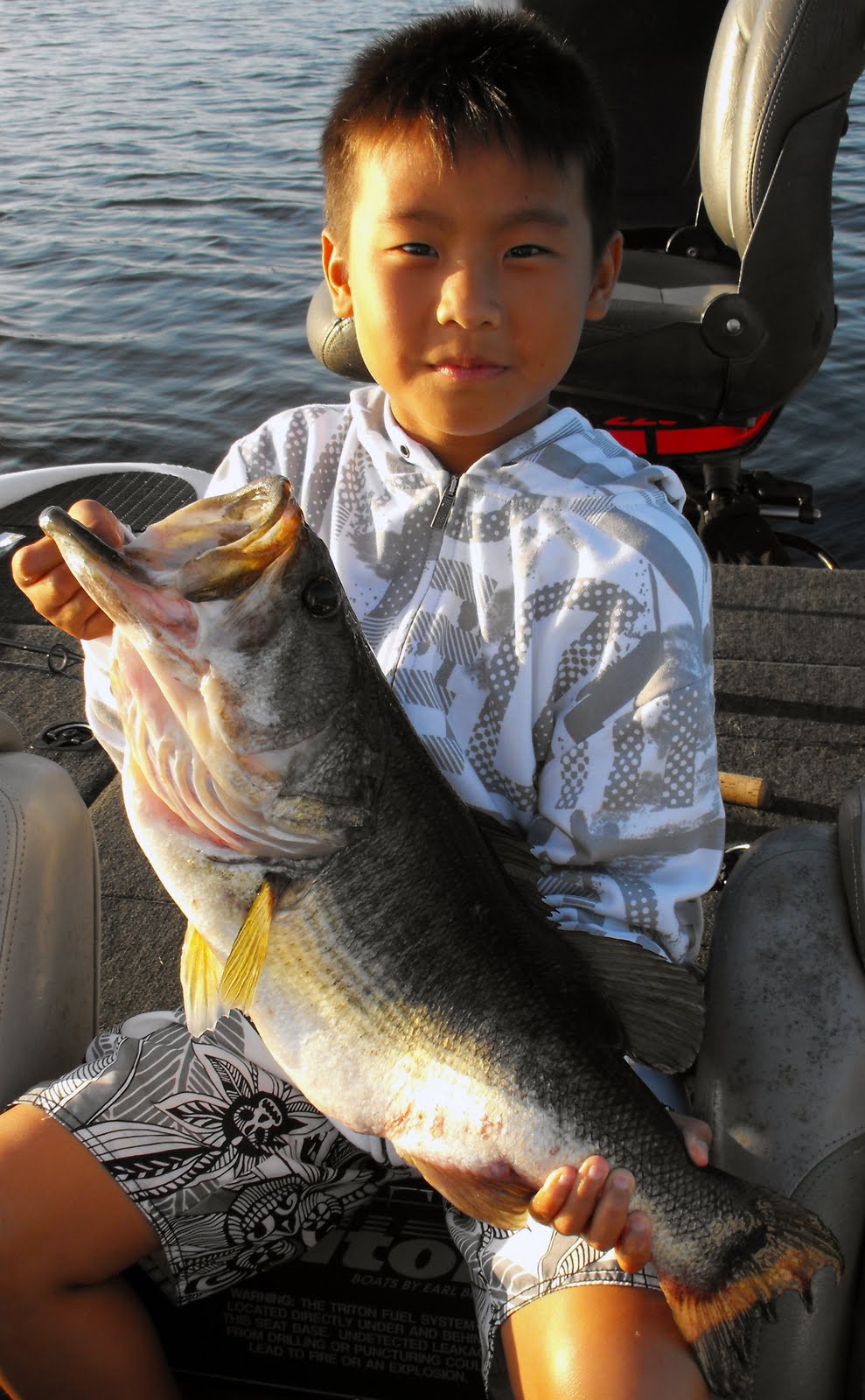
It's late August and typically a time when anglers in other areas of the country are having trouble locating bigger bass. Fortunately, here in Orlando the summer season can be very exciting especially during the first few hours of the morning. Florida Bass Adventures clients Bee and his 10 year old son Kevin Xiong found out just how good Orlando summer bass fishing can be during their day which was spent fishing Lake Toho.

Bee and his son Kevin from Minnesota chose to spend a day bass fishing with us during their Orlando vacation and hopefully catch some big bass. Bee had mentioned during our initial conversation how much his son would be looking for to the trip to Lake Toho. As Bee put it, Kevin often can be found fishing from sunup to sundown trying to catch bass back home. These trips are my favorite to do as a guide because kids are the future of our sport so being able to help mold their desire to continue fishing is an awesome opportunity for me.

We started out the morning meeting at the ramp to Lake Toho and then heading out to our first spot of the day. Not long after anchoring the boat and putting our bait into the water Kevin hooked up with his first bass of the day. Shortly after taking photos and releasing the first bass Bee set the hook on a nice 4 1/2 lb bass that put up an excellent fight before coming into the boat for more pictures. For the next 40 minutes Bee and Kevin continued to catch bass that were all above 4 lbs with the largest being a healthy 7lb bass that Kevin caught. This was his biggest bass ever leading Kevin to say that Lake Toho was definitely his favorite place to fish.

It is very rewarding to hear the excitement kids get when they are out for a day with us and Kevin definitely was enjoying the success of his day. Trips to Costa Rica catching Mahi Mahi didn't come close to how good this day was and before the trip was over Kevin was asking his Dad when they would be coming back to Orlando.

If you are unsure of what to expect when coming to Orlando for a day of bass fishing take a look at the awesome memories Bee and Kevin will go home with from their day. Bass fishing in Orlando is a year round opportunity with great weather and big bass that our lakes produce. Lake Toho is minutes from Orlando area theme parks and definitely should be at the top of anyones list when considering a bass fishing trip.

Florida Bass Adventures has been guiding clients to trophy bass in Orlando since 2003 specializing in trophy bass fishing on Lake Toho. For more information or to book a trip visit our site. Trophy bass fishing is all we do so feel free to take a look around and see what we have been up to!

http://www.floridabassadventures.com/

Sincerly,
Steve Boyd